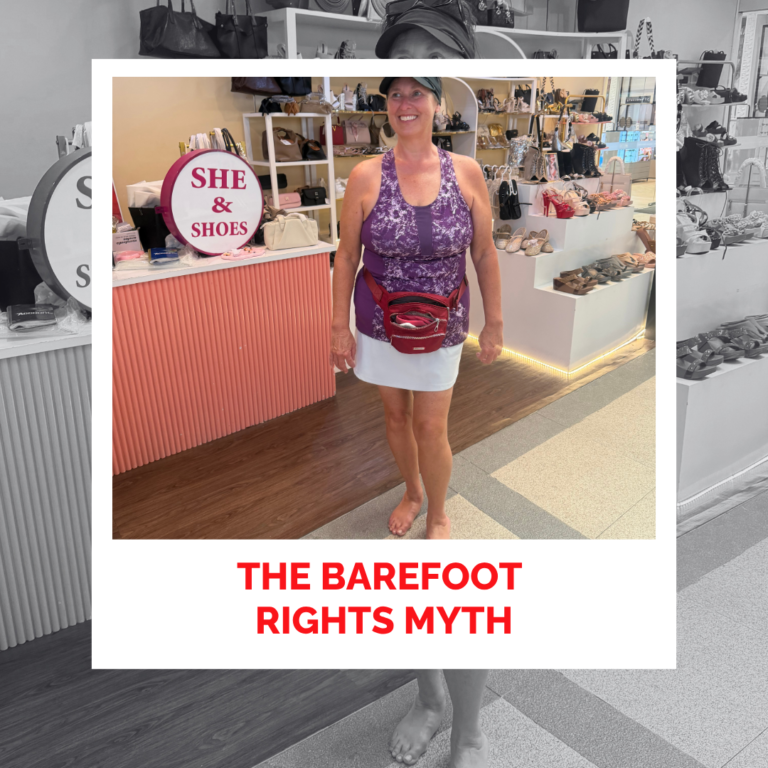
Tea and a Truth Biscuit: The Barefoot Rights Myth: What Nobody F*cking Tells You
For years, barefoot advocates have shared cards, memes, websites, and legal-sounding statements telling people that being barefoot is legal and that civil rights laws protect their right to remain barefoot in public places.
And parts of that are absolutely true.
But here is the giant Truth Biscuit nobody seems very excited to serve:
“Barefoot is legal” does not automatically mean “I have a legal right to be barefoot anywhere I damn well please.”
Those are two very different statements.
And when we blur that distinction, we can unintentionally send barefoot people into restaurants, gyms, stores, hotels, transportation systems, and other businesses believing they possess legal protections that may be far narrower, more conditional, or more difficult to enforce than they have been led to believe.
I know because I believed some of it too.
I have spent years living barefoot, advocating for barefoot acceptance, researching civil-rights protections, requesting religious accommodation, filing complaints, gathering evidence, and challenging organizations that told me to put shoes on.
And after getting much deeper into the legal system than I ever intended to go, I learned something I think the barefoot community desperately needs to talk about:
There is a massive difference between something being legal and you having an enforceable legal right to do so.
That distinction matters.
A lot.
The Card That Sounds Like a Court Order
Take one of the Arizona “Civil Rights” barefoot cards circulating online.
It states that Arizona civil-rights laws protect a person’s right to go barefoot for religious, cultural, medical, or disability reasons.
Then it goes considerably further:
“No one, including business owners or employees, can tell a barefoot patron to leave, or to put on shoes.”
Holy sh*t.
If I were a barefoot person carrying that card, what would I reasonably believe?
I would believe the law clearly says a business cannot require me to wear shoes.
I would believe I have an established legal right.
I might even hand that card to an employee with complete confidence and say, “You cannot legally make me put shoes on.”
There is just one problem.
The law is nowhere near that simple.
Legal Does Not Mean Protected Everywhere
In most places in the United States, simply being barefoot is not itself illegal.
There is generally no mysterious health-code law requiring every customer entering a grocery store or restaurant to wear shoes.
That myth deserves to die.
But killing one myth should not require creating another.
Private businesses can generally establish reasonable rules for customers, including dress or footwear policies, subject to applicable anti-discrimination laws.
That is where the conversation becomes much more complicated.
If a footwear requirement conflicts with a sincerely held religious practice, disability-related need, or another legally protected characteristic, anti-discrimination law may come into play.
But even then, the existence of a protected characteristic does not necessarily create an automatic, unconditional barefoot exemption.
There may be questions about whether the law applies to that business, whether an accommodation is required, whether the requested modification is reasonable, whether an exception creates an undue burden or legitimate safety issue, what evidence supports the business’s decision, and what legal standard applies in that particular jurisdiction.
That sounds considerably different from:
“No one can tell you to put shoes on.”
Because it is.
The ADA Card Has the Same Problem
Another barefoot card invokes the Americans with Disabilities Act and 28 CFR Part 36.
The regulation quoted on the card is real.
Public accommodations covered by the ADA cannot discriminate against people because of disability, and businesses may be required to make reasonable modifications to policies when necessary to provide access.
That is important law.
But the regulation itself does not establish a general federal “right to go barefoot.”
Barefooting may be the modification someone requests.
Whether the business must grant that particular modification depends on the individual facts and applicable ADA standards.
Again:
A right to request accommodation is not identical to an automatic right to receive exactly the accommodation requested.
That distinction may not fit neatly onto a wallet-sized advocacy card.
But it matters enormously when somebody’s actual rights are on the line.
Why This Matters to Me
This is not an abstract legal argument for me.
I have personally pursued barefoot accommodation complaints involving religious discrimination.
I genuinely believed I had strong legal protections.
And I had reasons for believing that.
I had read advocacy material. I knew barefooting itself was legal. I understood that religion was protected under civil-rights laws. I knew businesses could not simply discriminate because they disliked someone’s religious practice.
All true.
But what I did not fully appreciate was how much territory exists between:
“Religion is protected”
and
“Therefore this business must allow me to remain barefoot.”
There is a whole f*cking legal universe living between those two sentences.
And barefoot people deserve to know that before they spend months—or years—fighting a battle based on an understanding of their rights that may have been oversimplified from the beginning.
This Is Not an Argument for Giving Up
None of this means barefoot people should roll over every time somebody demands shoes. Quite the opposite.
Ask questions.
If someone says, “It’s the law,” ask which law.
If they say, “Health department regulations require shoes,” ask to see the regulation.
If there is a written footwear policy, ask to see it.
If your barefoot practice relates to religion or disability, ask whether an accommodation process exists.
If a business claims safety concerns, ask what actual risk assessment supports them.
Document what happens.
Challenge bullsh*t when you encounter it.
But do it knowing what your legal position actually is.
Because there is enormous power in saying:
“Show me the policy.”
There is power in saying:
“Please consider an individualized accommodation.”
There is power in saying:
“What specific safety concern applies to me in this situation?”
There is considerably less power in confidently announcing:
“You legally cannot make me wear shoes,”
if the law does not actually say that.
We Need Better Barefoot Advocacy
The barefoot community does not need exaggerated claims.
We do not need official-looking cards that make complicated civil-rights law sound absolute.
We do not need to convince people that barefoot freedom exists by pretending every disagreement is legally prohibited discrimination.
We need accurate information.
We need nuance.
We need to understand the difference between:
legal behavior, business policy, discrimination, accommodation, and an enforceable civil right.
Those five things are not interchangeable.
And perhaps one of the greatest services we can provide barefoot people is not telling them what they want to hear.
It is telling them what they actually need to know.
Wisdom Nugget
Knowing your rights is empowering. Believing you have rights the law never actually gave you can cost you time, energy, money, and peace.
Barefoot is legal.
But that sentence is only the beginning of the conversation.
I love all you people.
Love and ((HUGS)),
Laura Foster, Founder of Souls Healing Humanity